The markets are going to boom. The country is going to boom.
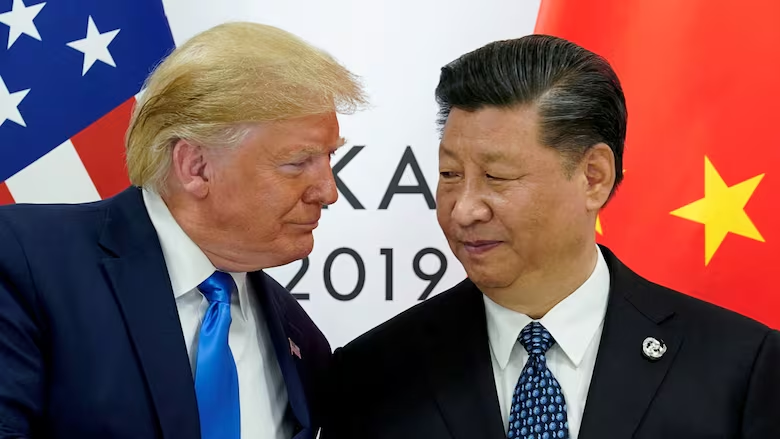
On April 2, 2025, President Trump stood in the Rose Garden and announced the broadest tariffs in modern American history. By the next morning, Wall Street had a verdict, and it was nearly unanimous: this would break the economy. JPMorgan titled its research note "There Will Be Blood." Larry Summers called it the most masochistic economic policy ever self-inflicted. The University of Michigan's consumer sentiment index cratered to its lowest reading since 2022.
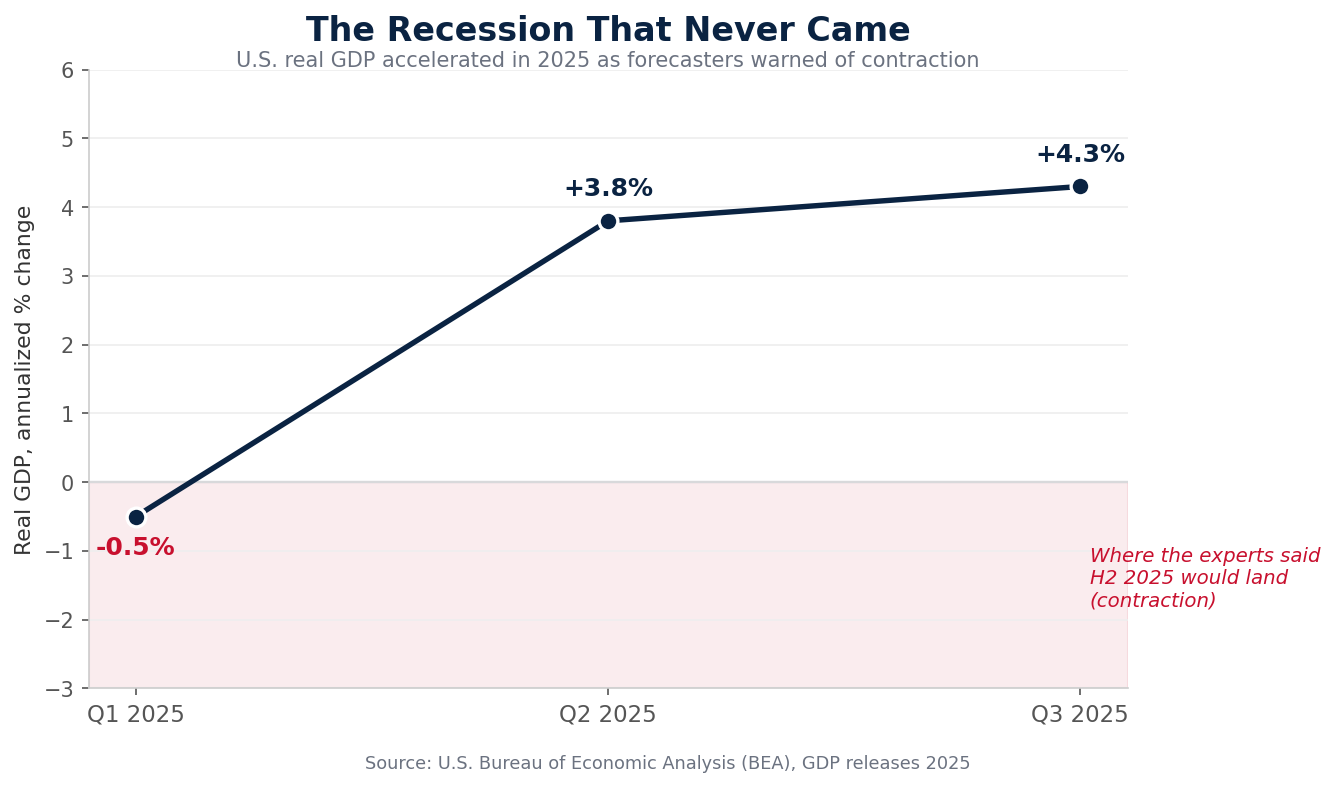
Eight months later, the receipts came in. Third-quarter GDP grew at a 4.3% annual rate. The S&P 500 closed at an all-time high on Christmas Eve. Inflation finished the year at 2.7%, almost exactly where it started. The recession that the most credentialed institutions in finance had assigned a coin-flip probability simply never arrived. This is the story of a prediction that was specific, was testable, and was wrong.
The Forecast: A 60% Chance of Recession
This was not a vague unease. The biggest names on Wall Street put numbers on it, named the quarter, and went on the record. Here is who said what.
The Collapse Never Arrived
The forecasts were specific and they were dire. A tariff-driven recession in the back half of 2025. Contraction, mass layoffs, a market that had just suffered one of the largest two-day losses in its history sliding further into the abyss. Instead the economy did the opposite. It accelerated. Here is what the official data actually recorded.
What Actually Happened:
- Real GDP grew at a 4.3% annualized rate in the third quarter of 2025, up from 3.8% in the second quarter and well above the roughly 3.3% economists expected. That is the opposite of a contraction. Source: U.S. Bureau of Economic Analysis
- The S&P 500 hit a record close of 6,932.05 on December 24, 2025, and finished the year up roughly 17%. The market that was supposed to crash set all-time highs instead. Source: RBC Wealth Management
- Inflation stayed contained. The Consumer Price Index for December 2025 came in at 2.7% year over year, with core at 2.6%, far below the 4.5% and higher that some forecasters feared from the tariffs. Source: CBS News / BLS
- Unemployment never spiked. It held in a 4.1% to 4.5% band all year and ended December at 4.4%, nowhere near the 7.5% Moody's had sketched in its severe scenario. Source: CNBC / BLS
The clearest sign that the forecasters knew they had overreached came fast. On April 9, hours after Trump announced a 90-day pause on the steepest tariffs, Goldman Sachs withdrew the recession call it had issued that very morning, reverting from a 65% probability back to a no-recession baseline inside about an hour. A forecast with that short a shelf life was never really a forecast. It was a flinch.
On The Record, The Official Numbers
Official Confirmation:
U.S. Bureau of Economic Analysis, Gross Domestic Product, 3rd Quarter 2025 (Initial Estimate)
"Real gross domestic product (GDP) increased at an annual rate of 4.3 percent in the third quarter of 2025 (July, August, and September), according to the initial estimate released by the U.S. Bureau of Economic Analysis. In the second quarter, real GDP increased 3.8 percent."
View Official ReportNational Bureau of Economic Research, Business Cycle Dating Committee
The NBER's Business Cycle Dating Committee is the official arbiter of U.S. recessions. It identifies a recession as "a significant decline in economic activity that is spread across the economy and lasts more than a few months." No recession was declared for 2025. The committee's record of business cycle peaks and troughs shows no peak dated after the recovery from the 2020 contraction.
View Official RecordThe Vindication: The Numbers Settled It
Economic predictions are rarely this falsifiable. The critics did not hedge. They assigned probabilities, named the quarter, and forecast contraction. When the official data landed, it pointed the other way. Even Harvard's Kennedy School, no friend of the administration, was left writing a postmortem on why the crash it expected never came.
The widely forecast tariff-driven recession did not occur. Growth held up, the labor market remained resilient, and inflation did not spike to the levels many economists had warned about.
The Pattern:
- The institutions that put recession odds at 40-60% quietly walked those forecasts back as growth came in hot. Source: CBS News
- "Liberation Day" was covered as an economic catastrophe in the making; one year later the headlines were about records, not ruin. Source: Funds Society
What Has Surfaced Since Trump Returned
The recession forecasters predicted for the back half of 2025 did not arrive. The official year-end data is now on the record, and it settles the one question this article is about.
Full-year 2025 real GDP grew 2.1 percent (Bureau of Economic Analysis)
"The increase in real GDP in 2025 primarily reflected increases in consumer spending and investment." The economy expanded for the full year rather than contracting into the recession that had been forecast.
View Source, U.S. Bureau of Economic AnalysisLayoffs stayed contained and unemployment held stable, not spiking
Hiring slowed through 2025, but layoffs remained relatively contained, keeping the unemployment rate stable near 4.3 percent rather than surging the way a recession would require. The labor market softened without breaking.
View Source, PBS NewsGrowth continued into 2026 as hiring rebounded
Into 2026, employers added 172,000 jobs in May, roughly double what forecasters expected, with unemployment holding at 4.3 percent. The predicted collapse never became the base case it was sold as.
View Source, PBS NewsThe Bottom Line
None of that changes the one prediction this article is about. The single most repeated forecast of 2025, made by JPMorgan, Goldman Sachs, the IMF, Moody's, and a Nobel laureate, was that Trump's tariffs would trigger a recession in the back half of the year. They put a number on it. It was tested. It was wrong.
The scoreboard is not close:
- The forecast recession never happened. Third-quarter GDP grew at 4.3%.
- The predicted market collapse reversed into record highs by Christmas.
- Inflation stayed near where it started instead of spiking to the levels critics warned about.
- Unemployment held in the low fours, never approaching the 7.5% painted in the doom scenarios.
Trump's bet was simple. He said the country would boom and told Americans to hold their nerve while the experts told them to brace for impact. The experts assigned a coin flip to catastrophe, and the catastrophe did not come. That is worth remembering the next time the same voices, with the same confidence, forecast doom.