This Russia thing with Trump and Russia is a made-up story. It's an excuse by the Democrats for having lost an election.
Watch Trump Call It a Hoax
For more than three years, anyone who called the Trump-Russia collusion story a hoax was treated as a crank. The narrative was everywhere: collusion was all but proven, the walls were closing in, and only a conspiracy theorist would doubt it. Trump used one word for it from the beginning. He called it a hoax. He was mocked for it.
Then the special counsel finished. Robert Mueller's investigation, after nearly two years and roughly $32 million, did not establish a criminal conspiracy between the Trump campaign and the Russian government. And since Trump returned to office, a second wave of disclosures has arrived: declassified intelligence files, a 29-page Durham annex that had been physically hidden, and sworn testimony that the public was never shown when it mattered. This article is about what those receipts actually say. Not the slogans. The documents.
A word on standards, because it matters here. The honest position on a contested accusation is not "it might be true, to be fair." It is that the people making the accusation carry the burden of proving it. On the two load-bearing claims of the Russia story, that burden was never met.
How It Was Sold: "Collusion Is Proven"
This was not careful hedging from officials who said the evidence was thin. The most senior voices in the intelligence community and the press told the public the case was strong and the doubters were dangerous. Here is who said what, on the record.
The Hack Attribution Was Never Proven
The whole story rests on a foundation: that Russian state hackers stole the DNC's emails and handed them to WikiLeaks. It was repeated as established fact. But trace it back to the actual forensic record and the foundation is far softer than the public was ever told. The burden was on the accusers to prove the breach and the handoff. On the public record, they did not.
What The Record Shows:
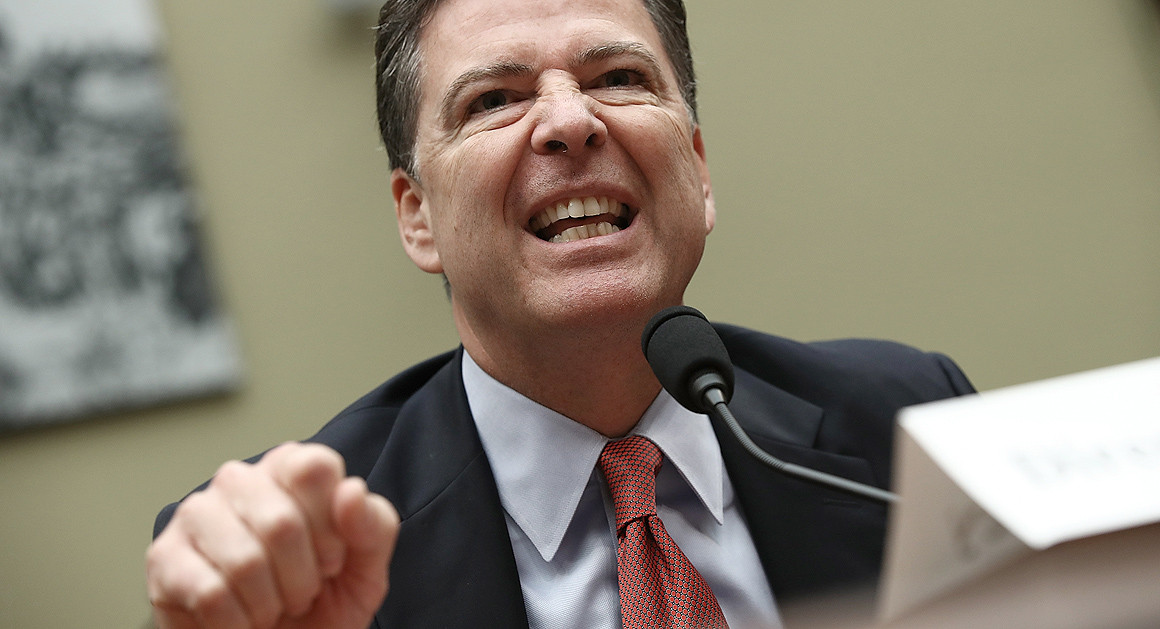
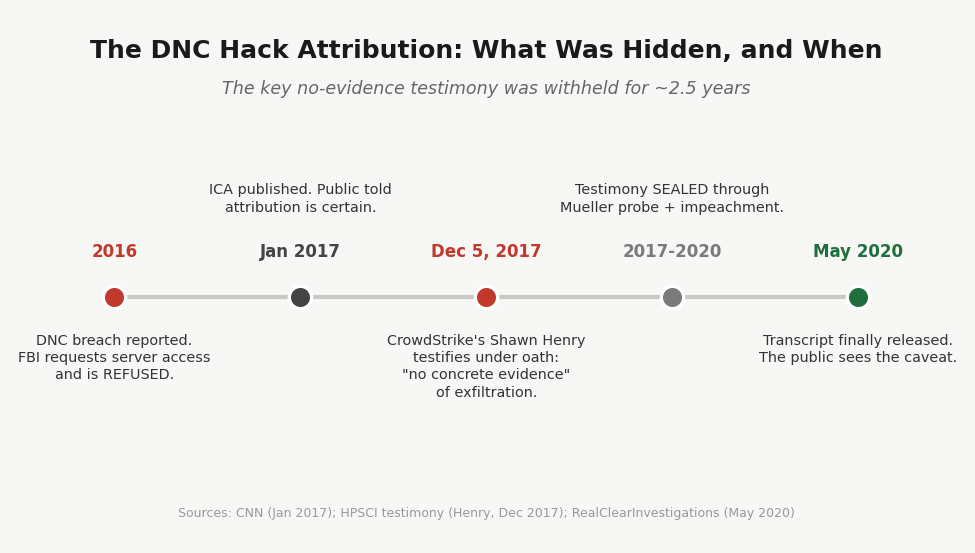
- The FBI never examined the DNC servers. The Bureau requested access and was refused; it relied instead on forensic images and reports from a private contractor. James Comey confirmed under questioning that the FBI "never got direct access to the machines themselves." Source: CNN
- That contractor was CrowdStrike, retained through Perkins Coie, the law firm working for the DNC and the Clinton campaign. The same firm also routed the funding for the Steele dossier through Fusion GPS, an arrangement the FEC later fined the Clinton campaign and DNC over for misreporting. The party accused of being the victim was paying the law firm that hired the investigators. Source: CNN / FEC
- Under oath before the House Intelligence Committee, CrowdStrike president Shawn Henry testified that there was "no concrete evidence" the DNC data was actually exfiltrated, only "circumstantial" indicators of activity consistent with exfiltration. The company that built the case had no proof the emails were stolen the way the public was told. Source: HPSCI testimony transcript (Henry)
- That testimony was given in December 2017 and then withheld from the public for roughly two and a half years, through the Mueller investigation and the first impeachment, before being released in May 2020. The most important caveat in the entire case was sitting in a transcript the public could not see. Source: RealClearInvestigations
None of this proves who took the emails. That is exactly the point. The public was told the attribution was certain. The forensic record underneath it was assembled by a paid contractor, never independently verified by the FBI on the original hardware, and accompanied by sworn testimony that there was no concrete proof of the theft itself. An accusation built on that foundation has not been proven. It has been asserted.
The "Putin Helped Trump" Verdict Was Manufactured
The second load-bearing claim was the January 2017 Intelligence Community Assessment's headline judgment: that Vladimir Putin ordered an influence campaign aimed at helping Trump win. It was presented to the country with "high confidence." But the sequence the declassified files lay out is the part that matters. Before the election, the intelligence community's own read was that Russia was not mounting a cyber campaign to swing the outcome. The "Putin helped Trump" verdict did not emerge from the evidence and then get oversold. It appeared after the election, was pushed from the top, and was assigned a confidence level the analysts underneath it never supported.
What The Files Show:
- Before the election, the intelligence community's assessment was that Russia was "probably not" trying to influence the outcome by cyber means. The high-confidence "Putin aspired to help Trump" judgment was not the original finding. It was a post-election reversal of what the community had concluded only weeks earlier. Source: Office of the Director of National Intelligence
- The reversal was directed from the top. The newly released Durham annex states that CIA Director John Brennan briefed President Obama on July 28, 2016, on intelligence describing a plan to "vilify Donald Trump by stirring up a scandal claiming interference by the Russian security service." The narrative was being shaped at the highest level of the administration months before the ICA was written. Source: Senate Judiciary Committee (Durham annex)
- When the assessment was finally produced, a later tradecraft review found the "aspired to help Trump" judgment was carried at high confidence by the CIA and FBI over analysts who rated it only moderate. The NSA, which holds the strongest signals intelligence, also held it at only moderate confidence. The "high confidence" label was a political headline, not a reflection of the analysis under it. Source: CIA tradecraft review (2025)
- To get there, the Steele dossier, the opposition-research file funded through the Clinton campaign's law firm, was folded into the assessment, despite later public claims that it played no role. The most discredited document in the saga was woven into the official finding the country was told to trust. Source: Senate Judiciary Committee
Put the sequence in order and the claim collapses. The pre-election read was that Russia was not running a cyber campaign to elect Trump. A scandal-building effort was briefed to the President in the summer. After the election, the conclusion flipped to the opposite of the original finding, was stamped "high confidence" over the objections of the analysts who did the work, and was propped up with a dossier paid for by the opposing campaign. That is not an intelligence finding that was merely oversold. It is a verdict assembled to fit a story that was decided first.
What Has Surfaced Since Trump Returned
The years since Trump took office again have produced the documents that the original investigators either never released or actively buried. These are the new receipts.
The New Record:
"Oxford Comma": The FBI Investigated Trump as a Russian Asset (declassified August 2026)
The White House declassified the originating memos for a secret FBI counterintelligence and criminal investigation opened on President Trump himself. Code-named "Oxferd Comma," a deliberate misspelling that would have kept it out of ordinary document searches, it began May 16, 2017, exactly one week after Comey was fired. Its premise: that Trump may have fired the FBI director while acting at the direction of the Russian government. The probe was approved by FBI General Counsel James Baker and Counterintelligence Deputy Bill Priestap. The lead agent assigned to it, William Barnett, concluded there was no evidence of collusion and asked to be taken off the case, later describing it as "a bad game of Clue." It was folded into the Mueller investigation and closed with nothing found. The sitting President was investigated as a foreign agent on a theory his own lead investigator did not believe.
View White House ReleaseODNI Declassification and Criminal Referral (Tulsi Gabbard, 2025)
The Director of National Intelligence declassified a tranche of files and a House Intelligence Committee report, and referred Obama-era officials to the Justice Department, alleging the Trump-Russia narrative was manufactured. The disputed contents are exactly that, disputed, but the underlying documents are now public and citable rather than sealed.
View ODNI ReleasesThe Buried Durham Annex (released by Sen. Grassley, 2025)
A 29-page classified appendix to John Durham's report, which FBI Director Kash Patel has said was found among "burn bags" of Crossfire Hurricane material, was released by the Senate Judiciary Committee. Material relevant to the origins of the entire investigation was physically hidden rather than disclosed. The receipt is the concealment itself: documents bearing on how the probe began were kept out of the public record for years, surfacing only after a change in administration.
View Senate Judiciary ReleaseGrand Jury Probe of Obama-Era Officials (DOJ, 2025)
Acting on a criminal referral, the Justice Department convened a grand jury to examine the officials who ran the Russia investigation. For years the people who built the narrative faced no scrutiny at all. The same conduct that was treated as off-limits is now in front of a grand jury. That is the receipt, and it is a measure of how far the ground has shifted.
View CoverageThe Vindication: Mueller Found No Conspiracy
For all the years of "the walls are closing in," the investigation built specifically to find collusion reached a plain conclusion. After 22 months, roughly 2,800 subpoenas, and around $32 million, the special counsel did not establish a criminal conspiracy between the Trump campaign and Russia. The man who had been called a conspiracy theorist for saying "hoax" was, on the central charge, right.
The investigation did not establish that members of the Trump Campaign conspired or coordinated with the Russian government in its election interference activities.
The Pattern:
- No American was charged with conspiring with Russia to interfere in the election. The prosecutions that did result were for process crimes and unrelated conduct, not collusion. Source: U.S. Department of Justice (Mueller Report)
- The one indictment that actually charged the alleged Russian election-interference operation never had to survive a courtroom. Mueller charged Concord Management, the company said to have funded the "troll farm," on the apparent assumption no Russian defendant would ever appear to fight it. Concord did appear, hired American lawyers, and demanded the government's evidence. Weeks before trial in March 2020, the Justice Department dropped the case rather than produce it, citing national security, after having told the court at the outset that the case required no classified evidence at all. The defense called it a "make-believe crime." The charge that was meant to stand as proof of Russian interference was abandoned the moment someone forced the government to prove it. Source: NPR
- Major outlets that had run the collusion story for years published postmortems acknowledging the coverage had outrun the evidence. Source: Columbia Journalism Review
The Bottom Line
Strip away the slogans and the saga comes down to two claims that the public was told were settled: that Russia provably hacked the DNC, and that the intelligence community had high confidence Putin acted to help Trump. The files that have surfaced do not settle who did what in 2016. What they do is dismantle the certainty that was sold to the country.
The scoreboard, kept honestly:
- The FBI never examined the server, and the contractor that did, paid by the accuser's own law firm, testified there was no concrete evidence the emails were stolen. That testimony was buried for two and a half years.
- The "high confidence" Putin-helped-Trump verdict was carried over analyst objections, leaned on the discredited Steele dossier, and reversed a pre-election assessment that said the opposite.
- The investigation built to prove collusion did not establish a criminal conspiracy.
- A 29-page annex relevant to the probe's origins was physically hidden until 2025.
This is not a case of a true story that was reported sloppily. The specific, load-bearing accusations that ran on a loop for three years were never proven to the standard the public was promised, and the burden was always on the people making them. Trump called it a hoax and was treated as a crank for it. He does not have to prove a negative. The accusers had to prove their case. On the record we now have, they did not.